
ListeningMind.AI / Wiki / Marketing AX for companies
Non-Customers: Growth Starts with Those Who Do Not Buy Yet
Non-customers are people who have not bought your brand yet, buy it only very rarely, or underuse the entire category despite having a need. Because they rarely show up in internal customer data, you must use behavioral data outside your company to understand why they do not buy.
ConceptDanny ParkCEO, Ascent AI·Updated 2026-10-22 15:20 KST·History · 2 contributorsEditSign in to edit
Three Groups of People
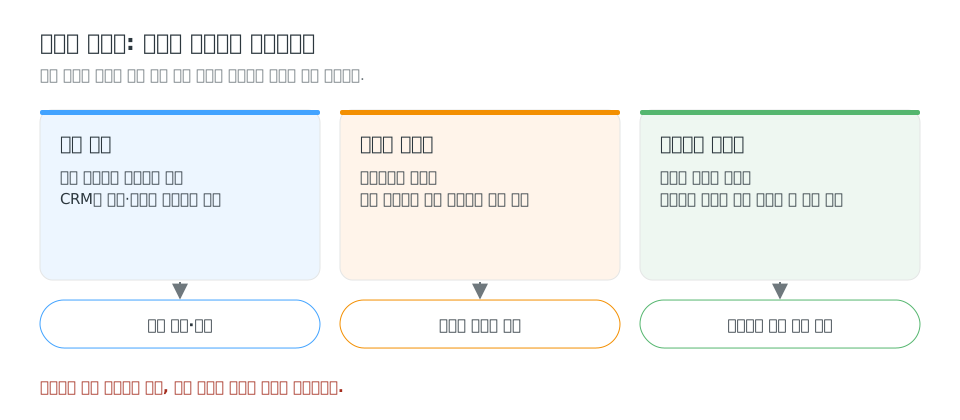
Customer retention and repeat purchases are important. However, selling more only to customers with whom you already have a relationship cannot indefinitely expand brand penetration and market reach. You must also ask why people who have not purchased so far chose not to buy. This perspective is emphasized in Japanese marketing research works such as Understanding Non-Customers and Non-Customer Strategy.
Why Internal Data Cannot Show Them
| Questions internal data answers | Questions about non-customers in the market |
|---|---|
| Who bought? | What is the reason for not buying? |
| What was sold? | What criteria are compared against other options? |
| Which campaign did they respond to? | What daily problem remains unsolved? |
The limitation of CRM and transaction data is not just a lack of volume. It lies in the fact that the data is biased toward people who already know or chose your brand. For this reason, you need to find external signals and link them with internal product, customer, and sales data.
| Data | Primary observation |
|---|---|
| Search | What friction leads to searching: explicit questions, demand shifts, search paths |
| Social | What is discussed and how people react: conversations, culture, sentiment, content |
| CRM and Commerce | Who actually buys and forms a relationship: transactions, usage, repeat purchases, conversions |
No single dataset fully represents the entire market. Problems that are not searched do not appear in search data, and experiences that people do not share publicly are missing from social data. When internal transaction data, search data, and social data are viewed together, the scope of interpretation widens.
The Unit of Understanding Is 'When and Why' Rather than 'Who'
When trying to understand non-customers, it is easy to think first of demographic attributes like age, gender, and occupation, or new personas. However, the exact same person applies entirely different selection criteria depending on their situation. Someone who usually prioritizes price looks for credible evidence when choosing a health product as a gift for their parents. Someone looking for a robot vacuum checks different requirements depending on whether they have pets, whether their home has high door thresholds, or whether automatic drainage can be installed.
The trigger that makes a consumer recall a category in a specific situation is called a Category Entry Point (CEP). Finding CEPs means discovering opportunities to connect your product with everyday situations where consumers do not choose your brand yet. New markets emerge when new everyday situations meet a clear reason to be chosen in that context. The conditions to examine after a CEP are covered in the Six Axes of Purchasing Decisions.
It Must Be Recalled, Accessible, and Processable by AI
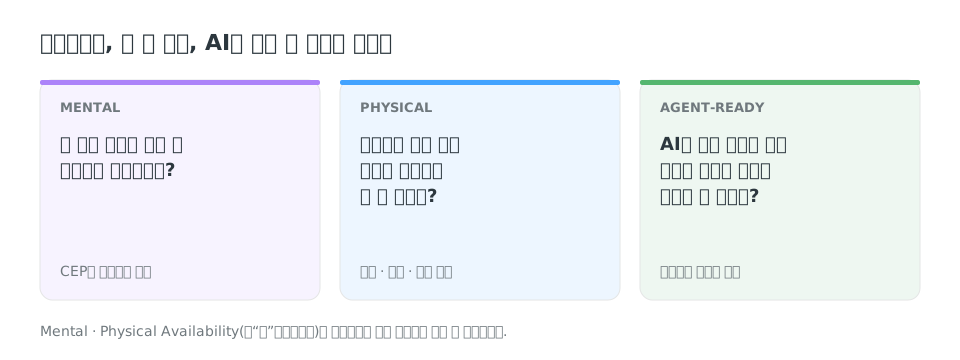
Customers must first be able to recall the brand in a specific everyday situation (Mental Availability) and easily find and purchase it in practice (Physical Availability). Adding touchpoints with an AI agent, we also look at whether AI can read product information, compare it, and carry out required actions (Agent-ready). This third element is an extended interpretation rather than a concept from the original books. For more details, see GEO + ACO + AOO.
How It Appears Across Industries
| Industry | Questions non-customers ask | Conditions to examine |
|---|---|---|
| Beauty and FMCG | When should I use it, and what should I avoid? | Skin type, portability, repeated use |
| Fashion | Does it fit well and feel comfortable in this situation? | Occasion, garment care, sizing |
| Home Appliances | Can it be installed and is it compatible in my home? | Installation requirements, repairs, maintenance costs |
| Services and Commerce | Is it a hassle to apply or purchase? | Eligibility, process, shipping, returns |
This table illustrates sample questions found through search queries and does not assume specific companies have these issues. Across every industry, the starting question remains the same: who is not our customer yet, and why?
What You Can Try Right Away
- CEP Finder: Build a map of purchase situations entering the category.
- Finding Non-Customer Barriers with Search Data: A step-by-step process for forming hypotheses using real search volume.
Questions
- Does non-customer mean the same thing as a new registered member?
- No. It includes not only people who have not registered yet, but also people who do not buy the brand, buy it only very rarely, or have not yet discovered new usage situations.
- Can you count the number of non-customers using search data?
- No. Search data is aggregated data that does not identify individuals, and search count is not a headcount. It is used as evidence of what problems non-customers experience.
- Does this mean we can spend less effort managing existing customers?
- No. Gaining new penetration and retaining existing customers do not substitute for one another. However, to widen the scope of growth, you must also look at people outside your existing customer base.
Sources
- 芹澤連, 『“未”顧客理解』
- 村山幹朗·芹澤連, 『“未”顧客戦略』