
ListeningMind.AI / Wiki / Intent Intelligence
Applying Toner Pad Search Queries to Product Planning
When planning a new toner pad or preparing product detail page copy, teams need to decide which product specifications and guidance details to review. Categorize recommendation, portioning, refill, and usage method search queries by topic, and separate observed metrics, interpretations, and hypotheses to test into verification tasks for product specification, pricing, distribution, and messaging.
GuideDanny ParkCEO, Ascent AI·Updated 2026-10-22 12:25 KST·History · 2 contributorsEditSign in to edit
What Questions Exist Within the Same 'Toner Pad' Search Queries?
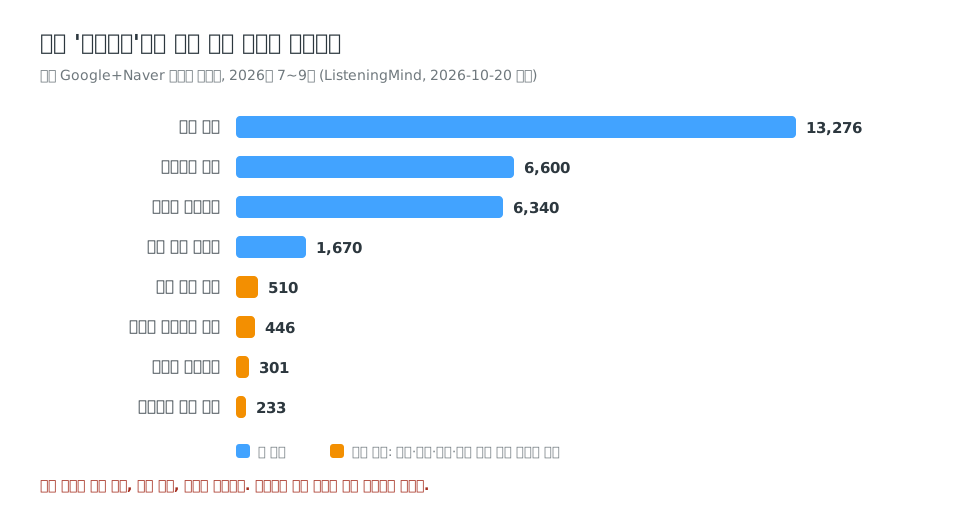
| Search Query | Monthly Average Search Volume | Topic Interpretation |
|---|---|---|
| 토너 패드 (Toner pad) | 13,276 | Entire category |
| 토너패드 추천 (Toner pad recommendation) | 6,600 | Selection criteria |
| 다이소 토너패드 (Daiso toner pad) | 6,340 | Distribution and price |
| 토너 패드 사용법 (How to use toner pads) | 1,670 | Usage method |
| 토너 패드 소분 (Toner pad portioning) | 510 | Portability and usage context |
| 메디힐 토너패드 리필 (MEDIHEAL toner pad refill) | 446 | Continued use and cost |
| 수부지 토너패드 (Dehydrated oily skin toner pad) | 301 | Skin suitability conditions |
| 토너패드 기내 반입 (Toner pad carry-on) | 233 | Travel usage constraints |
These are monthly average search volumes from South Korean Google and Naver from Jul to Sep 2026, retrieved from ListeningMind on Oct 20, 2026. The 'Topic Interpretation' column in the table classifies the search queries. Recommendations, distribution, and usage methods serve as starting points for reviewing selection criteria, purchase touchpoints, and usage guidance. However, queries such as portioning, carry-on, dehydrated oily skin, and refill do not automatically prove the existence of actual inconvenience or cost burden.
Search volume does not equal the number of searchers, market size, or sales. This number alone cannot confirm which questions actually prevented a purchase.
What Can Be Seen in Low Search Volume Keywords?
Looking only at high-volume keywords overlooks the minor inconveniences consumers experience. Questions such as portioning, carry-on, dehydrated oily skin, and refills may have low search counts, but they point to distinct issues: travel situations, skin suitability, and ongoing usage costs.
What Changes When Search Queries Are Converted into Purchase Contexts?
| Observed Search Query | Life Context (CEP Hypothesis) | What to Test in Product and Marketing |
|---|---|---|
| Travel, portioning | Carrying hygienically while going out or traveling | Portable specifications, small packaging, usage guidance |
| Dehydrated oily skin, acne | Can I use this for my skin condition | Official ingredients, suitability evidence, FAQ |
| Refill, cost | Is it convenient and economical for continued use | Refill policy, unit cost, purchase touchpoints |
Among the 'Observed Search Query' items in the table, 'travel', 'acne', and 'cost' are hypothetical expressions not present in the earlier observed data. The search queries used as observational evidence are '토너 패드 소분' (Toner pad portioning), '토너패드 기내 반입' (Toner pad carry-on), '수부지 토너패드' (Dehydrated oily skin toner pad), and '메디힐 토너패드 리필' (MEDIHEAL toner pad refill). The life contexts and items to test in product and marketing are all hypotheses, meaning they do not confirm actual inconvenience, product efficacy, or market performance.
How Are Facts, Interpretations, and Hypotheses Distinguished?
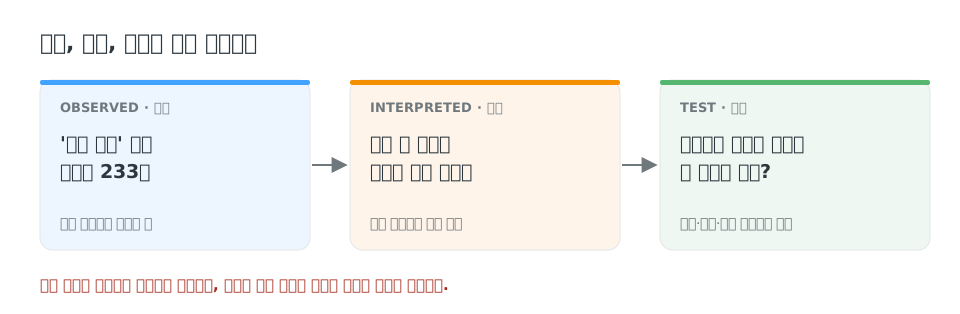
When incorporating search analysis results into a product proposal, distinguish between observed metrics, interpretations, and hypotheses to test. The monthly average search volume of 233 for '토너패드 기내 반입' (Toner pad carry-on) is an observed fact. The idea that portability during travel causes inconvenience is an interpretation of this query, which is not verified by search volume alone. The assumption that portable mini-packaging will attract new customers remains an untested hypothesis. Verify these interpretations and hypotheses through user interviews, actual product conditions, experiments, and sales data.
How Do Internal Departments Connect to a Single Consumer Problem?
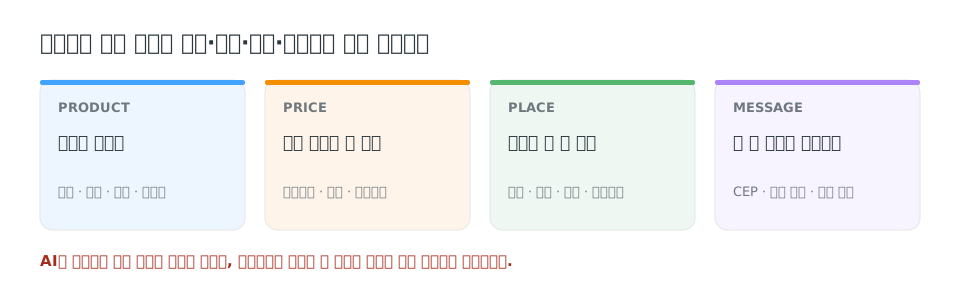
When verifying whether portioning is an actual reason for purchase hesitation, review packaging, unit price, display, shipping, and instructional content together. These conditions collectively influence a consumer's purchasing decision, yet different teams handle them internally. Therefore, share the hypothesis regarding portioning and organize it into verification tasks for each team across product specifications, pricing, distribution, and messaging.
How Should Tasks Be Assigned to an AI Agent?
Instead of asking, "Analyze the toner pad market," assign the task like this:
Find unresolved usage situations and purchasing conditions in South Korean toner pad search data.
Distinguish measured values from interpretations, and organize verification tasks for product planning, FAQs, and product detail pages.- Observe: Retrieve related search queries and search volumes. Call keyword_info, intent_finder, and path_finder via MCP.
- Interpret: Classify the topics appearing in the queries and organize hypotheses regarding life contexts and conditions based on the 6 Axes of Purchasing Decisions. Do not assume these are 'unresolved' problems; instruct the model to independently verify whether actual problems exist and whether they have been resolved.
- Execute: Separate and organize findings into product hypotheses, questions to verify in consumer FAQs, and official product data requests needed for product detail pages.
The key is to prevent the AI from guessing product efficacy and to ensure it clearly separates observations, interpretations, and hypotheses to test.
Questions
- What can be seen in low search volume keywords?
- Looking only at high-volume keywords overlooks the minor inconveniences consumers experience. Questions such as portioning, carry-on, dehydrated oily skin, and refills may have low search counts, but they point to distinct issues: travel situations, skin suitability, and ongoing usage costs.
- Can search volume be interpreted as market size or sales?
- Search volume does not equal the number of searchers, market size, or sales. This number alone cannot confirm which questions actually prevented a purchase.
- How are facts, interpretations, and hypotheses distinguished?
- On South Korean Google and Naver, the monthly average search volume for '토너패드 기내 반입' (Toner pad carry-on) was 233 from Jul to Sep 2026. The claim that portability during travel causes inconvenience is an interpretation. The assumption that portable mini-packaging will attract new customers is an untested hypothesis.
- How should tasks be assigned to an AI Agent?
- The key is to prevent the AI from guessing product efficacy and to ensure it clearly separates observations, interpretations, and hypotheses to test.