
ListeningMind.AI / Wiki / Intent Intelligence
Intent Knowledge Graph (IKG): 3 Layers and 25 Elements
The Intent Knowledge Graph (IKG) connects products, brands, consumer purchase contexts, selection criteria, and market decision knowledge across 3 layers and 25 element types, attaching evidence and sources to each sentence. It operates on demand, generated by topic when needed.
ConceptDanny ParkCEO, Ascent AI·Updated 2026-10-22 15:44 KST·History · 2 contributorsEditSign in to edit
Why Keyword Lists Are Not Enough
Extracting and listing terms like 'threshold', 'pet', 'noise', and 'price' from search data does not help AI evaluate products if it cannot explain how those terms relate to one another. Knowing four words like 'cat', 'threshold', 'cleaning', and 'robot vacuum' is fundamentally different from understanding the decision context: "Consumers trying to clean multiple rooms in homes with thresholds want to verify threshold clearance height and its test conditions."
Three Layers
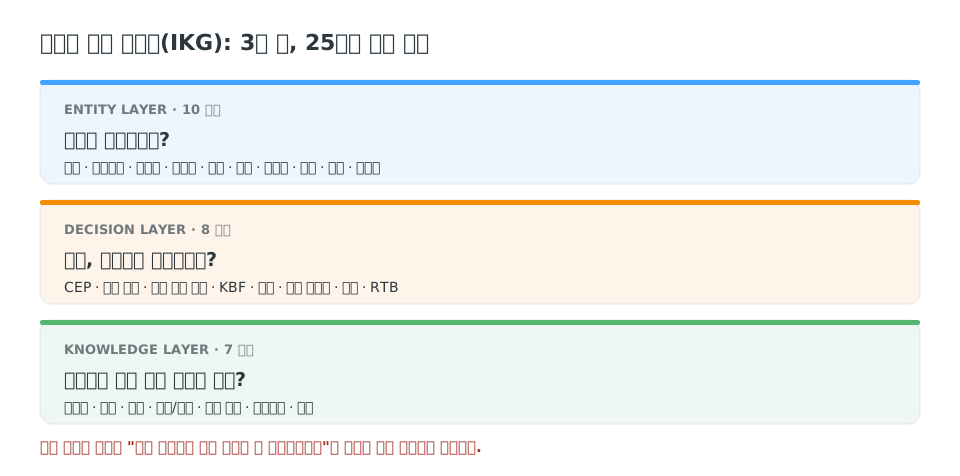
| Layer | Type | Contents |
|---|---|---|
| Entity layer | 10 types | Topic, category, entity, brand, product, attribute, customer segment, channel, alternative, content: what exists in the market |
| Decision layer | 8 types | CEP, usage context, sub-task, KBF, constraint, numeric threshold, avoidance, RTB: when and by what criteria choices are made |
| Knowledge layer | 7 types | Rule of thumb, convention, expectation, pitfall/caution, trade-off, benchmark, attitude: what decision knowledge exists in the market |
This does not mean every type must be populated. It is a standard framework for structuring elements verified in real data by topic. The Decision Layer and Knowledge Layer comprise the 15 intent elements defined by ListeningMind, and the analytical framework used to read them is the Six Decision Axes.
Captured as Sentences and Relationships, Not Words
Information in the Knowledge Layer is organized not as a word list, but as complete sentences and relationships. It expresses in sentence units why a specific performance condition matters when choosing a product, what constraints arise in exchange for a particular advantage, and what test conditions must be checked to validate a claim.
Recording Evidence Alongside Statements
Explanations that appear frequently in search results are not necessarily facts. Therefore, each sentence includes the following:
- Where the sentence originated (source)
- Whether additional independent evidence exists
- Whether it is up-to-date
- Whether it applies accurately to the product and category
Official product facts from manufacturers and sellers, decision knowledge observed in the market, and demand signals verified by search volume are also distinguished from one another. Observed claims are not automatically promoted to facts, and fields lacking sufficient evidence are left empty.
On-Demand IKG Built When Needed
Previously, building a customer decision structure for a product category required significant time and cost to collect data, categorize it, and define relationships. By connecting AI with search data infrastructure, the process of generating a graph, verifying evidence, and updating it when a topic is needed can be automated. Generation accuracy, verification, and automatic updates are areas being continuously refined.
IKG is not a technology that replicates individual consumer thoughts. It is a technology that reconstructs the collective purchase decision contexts observed in actual search behavior into an evidence-traceable structure.
Who Uses It and How
| User | Application | |
|---|---|---|
| Product Planning | Identifies which CEPs and selection criteria current products fail to address | |
| Marketing | Designs messaging tailored to life situations and jobs to be done | |
| Research | Distinguishes which hypotheses are supported by search behavior and which require further research | |
| Search and GEO | Identifies gaps where official brand information is missing from the conditions and evidence needed for answers | |
| Commerce | Applies differently to Product Listing Pages (PLP) and Product Detail Pages (PDP): [[aco-plp-pdp | ACO for PLP and PDP]] |
Once structured, intent knowledge does not end in a report; it is reused by enterprise systems and agents via API, MCP, and Skills.
Quick Links
- Topic Library: View pre-built topics across 15 elements.
- Intent KG: Generate a graph of topic elements and relationships.
Questions
- How does IKG differ from an internal enterprise knowledge graph?
- Internal knowledge graphs connect documents and data owned by the company. IKG connects purchase decision contexts observed from consumer search behavior outside the company. Using both together allows companies to cross-reference market questions with their product facts.
- Can sentences generated by AI be trusted as-is?
- Each sentence includes sources and evidence levels, so they must be reviewed together. Sentences lacking sufficient evidence are not treated as established facts.
- Are all topics built in advance?
- No. The default approach is on demand, generating them when a topic is needed. Pre-built topics can be viewed in the Topic Library.
Sources
- ListeningMind 용어 사전 · 2026-10-21